

Immunefi's Security Infrastructure Is Crypto's Next Asymmetric Bet
Talk to Immunefi IRImmunefi secures 70% of all DeFi TVL today.
Here's the long-term case for Immunefi and IMU securing all onchain value, and why that makes IMU a foundational crypto asset.
The Immunefi Foundation exists to save crypto from hacks and create a safe and resilient onchain economy. To that end, the Foundation launched IMU, a token purpose-built to power the Immunefi platform: the dominant security infrastructure layer in crypto, protecting over 70% of all DeFi TVL today. This document lays out the case for the Immunefi.com platform.
Since the Foundation's goal is to make crypto safe, the strength of that mission rests on the strength of the ecosystem IMU was built to power. The case for IMU begins with the case for Immunefi.
Throughout, "Immunefi" refers to the Immunefi.com platform, and "the Foundation" refers to the Immunefi Foundation.
Immunefi first launched in 2020 and pioneered crypto-native bug bounties at scale, facilitated the largest security payouts in internet history, and built the largest proprietary dataset of onchain vulnerabilities in existence. This dataset is adversarial and real-world. It reflects how attacks actually happen, not how they are theorized.
Today, Immunefi operates a unified security platform that integrates the full onchain security stack by bringing together best-in-class tools, orchestrating defense workflows, and automating response through a single command center. We are building toward what we call the Guardian Angel: an AI-driven security layer that watches over onchain operations 24/7, intercepting threats in real time while giving operators fine-tuned control over their security configuration.
This position is not accidental. Immunefi was built from the beginning to operate in adversarial, high-stakes environments where failures are irreversible and response time determines outcomes. Years spent coordinating real incidents, arbitrating critical vulnerabilities, and working alongside the most security-sensitive teams in crypto revealed a consistent truth: fragmented, human-operated security cannot scale to defend financial systems that move at machine speed.
As onchain value grows, the role of Immunefi shifts from optional enhancement to foundational infrastructure.
Immunefi is backed by Electric Capital, Framework Ventures, Samsung Next, North Island Ventures, and others. These backers reflect conviction from both crypto-native capital and strategic corporate investors that security infrastructure will be foundational to the onchain economy.
This page explains why security is the binding constraint on onchain growth, why the market opportunity is measured in hundreds of billions, and why Immunefi is uniquely positioned to capture it.
It also covers the Immunefi Foundation's IMU token and how it serves as the core value creation asset powering the Immunefi security platform.

The Problem
Security is the binding constraint on onchain growth
Over the past decade, crypto has evolved from an experiment into a parallel financial system.
In 2025, total cryptocurrency market capitalization approached $4 trillion. Stablecoins alone surpassed $300 billion in outstanding supply. TRM Labs reports that stablecoins accounted for roughly 30% of all onchain transaction volume, exceeding $4 trillion in throughput by August 2025, an 83% year-over-year increase.
Institutional capital is arriving. A recent analysis found that institutional investors now allocate an average of 9% of assets under management to digital assets, with projections suggesting growth to 18% within a few years. A Coinbase and EY-Parthenon survey found that 83% of institutions plan to increase digital asset allocations in 2025. By mid-2025, digital asset AUM surpassed $235 billion, with institutions controlling an estimated 65% of crypto investments globally.
The appeal is clear: real-time settlement, programmable financial products, and global access without intermediaries, which reduce operational friction, counterparty risk, and costs compared to traditional finance.
But there is one blocker preventing the onchain financial revolution from accelerating.
That blocker is security.
The Loss Rate Is Unviable
Since 2016, over $11.7 billion has been lost to hacks. More than $2 billion was lost in just the first half of 2025 against a total TVL of $111 billion. That's 1.8% of all capital gone in six months, implying an annualized loss rate of 3.6%.
The clear advantages of DeFi are irrelevant if more than 3.6% of value is stolen every year.
In its early years, crypto could afford to treat security failures as a cost of experimentation. Protocols were small, users were early adopters, and capital was explicitly risk-seeking. That tolerance no longer exists.
Security Failures Are Now Systemic Trust Failures
As the onchain economy has matured, it increasingly serves stablecoin holders, protocol treasuries, DAOs managing billions in assets, and institutions evaluating onchain infrastructure for real financial activity. Since onchain finance is deeply composable—sharing liquidity, dependencies, and risk across protocols—a single exploit propagates far beyond its point of origin. Losses cascade through integrated systems, counterparties, and users who may never have even interacted with the compromised protocol directly.
Each major failure weakens confidence not in one application, but in the reliability of the onchain financial stack itself.
Institutions Cannot Operate Under Current Risk Assumptions
Institutional capital is incapable of tolerating a 3.6% annual loss rate. Pension funds, asset managers, corporate treasuries, and sovereign entities are governed by fiduciary duties, regulatory mandates, and portfolio risk constraints that make unpredictable loss mathematically unacceptable. Even small but recurring probabilities of catastrophic failure compound into tail risks that cannot be diversified away at scale.
For these actors, security is a prerequisite for onchain participation, not a nice-to-have.
Regulation Is No Longer the Blocker
Major jurisdictions have already formalized crypto within existing financial law. The EU's MiCA framework went fully into effect in 2024, explicitly regulating stablecoins, custody, exchanges, and market abuse. The US approved spot Bitcoin and Ethereum ETFs, allowing trillions of dollars of institutional capital to gain compliant exposure. Global regulators including the BIS, IOSCO, and the Federal Reserve have published detailed guidance on tokenization, custody, and onchain settlement.
The US approved spot Bitcoin and Ethereum ETFs, allowing trillions of dollars of institutional capital to gain compliant exposure
Major banks such as JPMorgan, Goldman Sachs, and BNY Mellon are already operating tokenized funds and blockchain-based settlement rails under regulatory supervision. In January 2026, the New York Stock Exchange announced development of a platform for 24/7 trading and onchain settlement of tokenized securities, combining its existing matching engine with blockchain-based post-trade systems and stablecoin funding. Nasdaq has filed similar applications. The infrastructure of traditional finance is migrating onchain.
The Threat Landscape Is Evolving
The nature of threats has shifted far beyond simple smart contract bugs. In the earliest days of DeFi, the dominant vulnerabilities were coding errors: integer overflows, unchecked external calls, reentrancy. Protocols invested heavily in formal verification and manual audits to address this class of risk.
Today, the majority of losses stem from vectors that auditing alone cannot address. In 2024-2025, over 70-80% of value stolen came from access control failures, private key compromises, governance exploits, and infrastructure weaknesses, rather than novel smart contract bugs.
A stark example
In the first half of 2026, the North Korea-linked threat actor KONNI began deploying AI-generated PowerShell backdoors targeting blockchain developers. Instead of exploiting onchain code, the malware was delivered via phishing lures resembling legitimate project documentation, designed to compromise developer environments, source code repositories, and wallet credentials.
The Bybit hack of early 2025 (approximately $1.5 billion stolen) demonstrated how sophisticated attackers combine social engineering, infrastructure compromise, and operational security failures to bypass even well-audited systems. The smart contracts weren't the vulnerability; the humans and processes surrounding them were.
Seconds can determine whether funds are lost. This latency is a structural vulnerability
Even a formally verified smart contract is only one piece of the risk footprint if the development pipeline, signing infrastructure, or identity systems surrounding it are insecure. Static defenses like point-in-time audits, code reviews, and fixed security scans assume that threats are predictable and bounded by code structure. But adversaries today operate in a dynamic landscape where attack methodologies evolve rapidly.
AI is accelerating this evolution. AI-assisted adversaries can generate and deploy sophisticated malware in minutes, automatically adapting payloads, evasion techniques, and social engineering lures. The asymmetry between attack speed and defense speed is widening.
Existing Security Models Fail by Design
The dominant security models in crypto are inherited from Web2. They assume private infrastructure, mutable systems, and centralized control. These assumptions do not hold on public, immutable blockchains.
In Web2, systems can be taken offline, transactions reversed, access revoked, incidents resolved post-factum. Onchain systems remove these escape hatches. Transactions are final. Infrastructure is publicly accessible by default. Attackers face no geographic or permission barriers.
Each vendor operates on different data models, alerting standards, severity thresholds, and response assumptions
Despite this mismatch, most onchain security stacks remain collections of point solutions: audits for code correctness, monitoring tools for anomalies, bug bounties for live code review, analytics dashboards for visibility, incident response vendors for emergencies. Each tool may work in isolation. Together, they form a fragmented system with no unified control plane.
This fragmentation creates real operational cost. Each vendor operates on different data models, alerting standards, severity thresholds, and response assumptions. Security teams manually correlate signals across dashboards, emails, Discord messages, and ticketing systems, often under extreme time pressure. The result is alert fatigue, delayed response, and inconsistent decision-making precisely when speed matters most.
In a system where seconds can determine whether funds are lost, this latency is a serious vulnerability.
The Opportunity
Security as the take rate on onchain GDP
As the onchain economy grows, security is not a discretionary line item. It becomes a structural cost of doing business—a recurring "trust tax" that scales with value secured and transaction throughput.
The Economic Surface Area Already Exists
In 2026, total crypto market capitalization has been measured in the trillions.
The growth trajectory is steep. DeFi TVL, which measures capital actively deployed in decentralized protocols, has fluctuated between $50 billion and $200 billion over recent cycles, but the trend is structurally upward as new use cases emerge and institutional participants enter. Each dollar of TVL represents capital that requires continuous security coverage.
Beyond traditional cryptocurrency exposure, the tokenization of real-world assets is transitioning from pilot to scaled adoption. By mid-2025, the market for tokenized real-world assets had grown to more than $24 billion, an increase of roughly 85% year-over-year. Major banks and asset managers are launching production-scale tokenized products: tokenized money-market funds, treasury funds, and private credit instruments are gaining significant traction. BlackRock's BUIDL fund, Franklin Templeton's OnChain U.S. Government Money Fund, and similar institutional products represent early signals of where the market is heading.
The key point is not the precise number. The key is that the industry's trajectory is measured in multiples, not percentages.
Security Spend Scales with Value at Risk
In traditional finance, security and operational resilience budgets scale with assets under custody, transaction volume, and exposure to tail risk. Large financial institutions allocate security spend based on unacceptable outcomes: loss of client funds, settlement failure, regulatory breach, systemic contagion.
This same logic applies onchain, but with greater intensity.
Onchain systems structurally require higher security spend per dollar of value than traditional systems




As capital concentrates onchain and protocols become deeply composable, loss correlations rise. Security demand grows superlinearly with onchain GDP: more value does not just mean proportionally more risk, but also more systemic risk.
The Traditional Cybersecurity Market Provides Context
The traditional cybersecurity market is already enormous. Gartner forecasts $212 billion in global information security spending in 2025, while broader market estimates place total cybersecurity spending above $270 billion annually.
As traditional financial institutions move onchain through using public and hybrid blockchains for settlement, tokenized funds, deposits, and real-world assets, the distinction between "crypto security" and "traditional cybersecurity" breaks down.
Existing security budgets will extend into the onchain environment, since security spend follows risk exposure, not labels.
Reframing the Market
Onchain security is not a SaaS category defined by number of protocols, audits, or tools sold. The relevant total addressable market is best measured as a percentage of onchain GDP—the value settled, held, and transacted onchain.
Consider the math. If onchain GDP reaches $10 trillion in transacted value annually, and security represents even a 0.5% take rate, that implies a $50 billion annual security market. At 1%, which is conservative relative to traditional financial infrastructure costs, the market reaches $100 billion.
As that GDP grows from trillions toward tens of trillions, security becomes a durable take rate on economic activity, analogous to custody, clearing, and settlement costs in traditional finance. Custody fees alone represent tens of basis points on assets under management. Clearing and settlement infrastructure extracts similar economics.
Security infrastructure will follow the same pattern.
Protocols managing significant treasuries cannot afford the reputational and financial consequences of a security failure
Once institutional workflows incorporate onchain rails, security requirements harden permanently. Standards rise, loss tolerance collapses, and security spend increases with scale rather than compressing margins. Participation by large institutions mechanically increases total security spend, because higher assurance and continuous coverage are required to unlock flows.
This dynamic is already visible. Protocols managing significant treasuries—whether $100 million or $1 billion—cannot afford the reputational and financial consequences of a security failure. Their security budgets are growing from five figures to six and seven figures annually as the stakes increase. Institutional entrants arriving with fiduciary obligations will accelerate this trend further.
Solving onchain security is not merely about reducing losses. It captures a share of the value created by onchain finance itself by enabling safe settlement, capital concentration, and sustained trust at scale.
The opportunity is measured in hundreds of billions of dollars, with a growth trajectory tied to the expansion of the onchain economy.
The Solution
Today's security posture across crypto is assembled from discrete components
Audits performed at fixed points in time, bug bounties run in isolation, monitoring tools that generate alerts without context, incident response that relies on human coordination under extreme time pressure.
A Unified Security Layer and Command Center
The platform is designed as a unified security layer that brings the entire onchain security stack into one place and makes those components work together as a system. The objective is not marginal improvement but a step-change in security outcomes: faster detection, reduced exploitability, and response at the speed required by always-on financial infrastructure.
At its core, the Immunefi platform functions as a single command center for onchain security. Rather than replacing existing tools, it integrates them. Immunefi aggregates its own first-party security capabilities—bug bounties, audit competitions, CI/CD security—together with best-in-class third-party tooling for monitoring, firewalling, wallet and multisig protection, and threat detection.
Over 30 leading security firms have already requested integration, recognizing that isolated tools cannot deliver system-level protection.
What changes is not the presence of tools, but how they interact. Signals from across the security surface flow into one system. Vulnerabilities discovered through bug bounties inform runtime defenses. Findings from audits feed directly into monitoring and prevention. Alerts are correlated, prioritized, and contextualized before action is taken.
Instead of security teams manually stitching together dashboards, emails, and Discord messages, the platform maintains a shared, system-wide view of risk.
Securing the Full Lifecycle
The platform covers the entire security lifecycle
Traditional security approaches treat these phases separately. Onchain systems cannot afford that separation. A vulnerability discovered post-deployment must immediately inform runtime defenses. Runtime anomalies must trigger automated responses, not just alerts. Response actions must feed back into future prevention.
The Immunefi platform shifts security from episodic validation to persistent defense, with automation, compressing response times from hours to seconds.
Why Humans Cannot Be the Control Plane
Immunefi's perspective is shaped by years spent inside high-stakes security war rooms where billions of dollars were at risk and decisions had to be made under extreme pressure.
In these situations, failures rarely stem from lack of expertise. They stem from latency.
Humans cannot reliably defend systems that operate at machine speed. Manual triage, governance approvals, and ad-hoc coordination introduce delays that attackers exploit systematically.
The platform uses automation to remove human bottlenecks where speed matters most, while preserving human oversight where judgment and context are required.
From Orchestration to Autonomous Defense
AI-driven workflows coordinate actions across integrated tools, enabling responses that would be impractical or impossible to execute manually at scale: automatically testing newly discovered vulnerabilities across all secured systems, dynamically updating firewall rules based on emerging threats, pausing suspicious contract activity in real time.
These workflows already compress multi-hour expert processes into seconds, often with higher consistency than manual review.
Failures rarely stem from lack of expertise. They stem from latency
As the platform is used, it generates a unique class of security data: real exploit reports, mitigation strategies, response decisions, and outcome feedback across hundreds of protocols. This data foundation enables progressively more autonomous defense—the Guardian Angel vision: an intelligent layer that continuously watches over onchain assets, anticipates threats, and intervenes before damage is done.
Business Model
Immunefi monetizes as a recurring platform that functions as the coordination and control layer for onchain security. Customers subscribe to a unified security platform that consolidates prevention, detection, and response workflows into a single operational system.
Pricing is structured around access and usage rather than explicit value-at-risk. Customers pay for platform seats, scope of access, and inclusion of the full security stack, lowering friction in early adoption while supporting expansion as usage deepens.
Adoption typically begins at a single entry point—most commonly a bug bounty program—where Immunefi already operates as the industry default. From there, customers expand organically as additional security functions are routed through the platform.
Crucially, Immunefi captures value not by commoditizing security services, but by owning the coordination layer. Third-party security providers integrate into the platform rather than compete with it, allowing Immunefi to orchestrate best-in-class tools while remaining the system of record for security decisions, workflows, and outcomes.
Over the long term, as the onchain economy matures and institutional participation deepens, pricing can evolve to more directly reflect value secured, mirroring how security, custody, and clearing fees function in traditional financial infrastructure.
Why Immunefi Wins
Security infrastructure does not scale linearly. It compounds.
In adversarial systems, every additional participant, data point, and incident response either strengthens the defender or the attacker. The defining question is who captures the learning.
Immunefi's advantage lies in having designed its platform and business model so that every interaction makes the system stronger, not just larger.
The Data Advantage
More than 90% of all material blockchain bug bounty disclosures over the past four years have flowed through Immunefi. This has produced a dataset unlike anything else in the industry: the largest proprietary collection of real-world onchain vulnerabilities in existence.
This is adversarial data. It reflects how attacks actually happen in production, not how systems are expected to behave in theory.
This advantage was not inevitable. It was the result of deliberate early choices:
- Prioritizing researcher incentives and trust
- Focusing on real exploitability rather than checklist compliance
- Integrating deeply with the most security-critical protocols
Once established, this data advantage compounded. Each new protocol added context. Each new disclosure refined pattern recognition. Each response improved institutional understanding of risk.
The Researcher Network
Immunefi operates the largest and most active security researcher network in the onchain economy. More than 60,000 security researchers have contributed to our threat dataset, including all ten of the highest-paid whitehat hackers in internet history. Immunefi has facilitated $125 million in bug bounty payouts, the largest cumulative payouts in Web3 security.
Security research is a power-law market: a small number of elite researchers consistently find the most critical vulnerabilities, while long-tail participation surfaces edge cases and novel attack patterns. Immunefi's platform concentrates both ends of this distribution, creating a self-reinforcing loop:
- Elite researchers are drawn to Immunefi because it hosts the largest bounties and the most important protocols
- Protocols are drawn to Immunefi because the best researchers are already there
- Each successful disclosure increases trust, payout velocity, and researcher retention
Cross-Protocol Intelligence
Unlike traditional security vendors that operate on a per-customer basis, Immunefi sits at the intersection of hundreds of protocols and security events. This enables cross-protocol threat intelligence that isolated teams cannot replicate.
A vulnerability discovered in one protocol is rarely unique. Attack patterns repeat across codebases, governance structures, wallet configurations, and operational practices. The same reentrancy pattern that compromised one lending protocol may exist in a dozen others. The same governance misconfiguration that enabled a hostile takeover in one DAO may be present across the ecosystem.
Because Immunefi sees these patterns across hundreds of live systems, it could:
- Detect emerging attack vectors before they become widespread
- Translate one protocol's failure into preventative action for many others
- Reduce the time between discovery and defense from weeks to minutes
- Identify vulnerability classes that span multiple protocols simultaneously
This is a classic learning effect: every incident improves the platform's predictive power, reducing marginal risk for all participants. The more protocols that participate, the better the intelligence. The better the intelligence, the more valuable participation becomes.
Shared defense is efficient and necessary in a composable financial system. Onchain finance shares liquidity, governance, and execution across protocols, meaning that risk is correlated, not isolated. A failure in one system often cascades into others, as seen repeatedly in bridge exploits, oracle failures, and governance attacks. By coordinating disclosures, defenses, and response workflows across its customer base, Immunefi reduces systemic risk, not just protocol-specific risk.
This is similar to how clearinghouses and central counterparties reduce contagion in traditional finance by enforcing shared standards and mutualized safeguards. The difference is that onchain systems require this coordination to happen at machine speed.
Track Record: Evidence of Execution
When Immunefi launched in late 2020, crypto security was fragmented and underdeveloped. Audits dominated the landscape, despite being static, expensive, and poorly suited to adversarial systems that evolve continuously. Bug bounties existed in Web2, but in crypto they were underutilized, inconsistently run, and often distrusted.
Starting with bug bounties was not the obvious choice. They were perceived as tactical, reactive, and difficult to manage. But they offered two properties that other security approaches did not:
- They attracted adversarial talent
- They generated real exploit data
Immunefi recognized early that securing open financial systems required engaging the same caliber of talent that attackers relied on, and aligning incentives so that this talent worked defensively instead. By standardizing bounty programs, scaling payouts, and professionalizing disclosure and mediation, Immunefi transformed bug bounties from an afterthought into a primary defense mechanism.
The results speak in concrete numbers:
- Multiple $10M+ bounty payouts, the largest in internet history
- $25 billion+ in losses prevented, calculated based on the severity and exploitability of vulnerabilities disclosed
- 80% of customers have received valid critical vulnerability disclosures via the platform
- Thousands of valid vulnerability reports processed, creating the industry's most comprehensive dataset of real exploits
Security is a trust market, and trust accumulates asymmetrically. Protocols and institutions do not switch security providers casually. They remember who performed under pressure, who handled disclosures responsibly, who protected them when the cost of failure was existential.
Today, Immunefi secures hundreds of protocols, including some of the largest and most security-sensitive systems in crypto.
































It is the platform teams turn to not only for prevention, but for coordination when vulnerabilities are discovered and incidents unfold. The operational experience accumulated across thousands of reports, hundreds of coordinated disclosures, and numerous high-pressure war rooms has created institutional knowledge that cannot be replicated quickly:
- How attackers behave under real constraints
- Which controls fail in practice
- How governance and human factors interact with technical risk
- How to coordinate multiple stakeholders during live events
This learning does not reset each cycle. It compounds.
Why Competitors Cannot Easily Replicate This Position
The Web3 security market is fragmented across specialized providers. Competitors excel in narrow slices, such as audit contests, bug bounties, monitoring, formal verification, but none has built the unified security platform that integrates the full stack. This fragmentation is the problem Immunefi exists to solve, and it is also the source of Immunefi's competitive advantage.
Traditional cybersecurity incumbents like CrowdStrike and Palo Alto Networks have the capital, talent, and enterprise relationships to enter any market they choose. But onchain security inverts the assumptions their platforms are built on. Traditional cybersecurity assumes private infrastructure, mutable systems, reversible actions, and centralized control, environments where you can take systems offline, revoke access, and remediate post-incident.
Onchain systems offer none of these escape hatches: smart contracts are immutable, transactions are final, infrastructure is publicly accessible, and there is no "rollback" when funds are stolen. Beyond the technical mismatch, traditional vendors lack the domain-specific credibility that matters in crypto: no adversarial onchain data, no relationships with the security researcher community that finds the most critical vulnerabilities, no understanding of crypto-native governance and multisig operations, and no track record of performing under the specific pressures of onchain incidents.
This isn't theoretical. HackerOne, the dominant bug bounty platform in Web2, operated Web3 bug bounties and attempted to expand further into the space when Immunefi launched. They had every structural advantage: brand recognition, an established researcher network, and years of platform infrastructure. It didn't matter. Immunefi's crypto-native expertise, platform, and focus on the specific dynamics of onchain security made HackerOne's generalist approach uncompetitive. Today, HackerOne is not a relevant player in Web3 security. The lesson: capital and scale cannot substitute for domain expertise and accumulated trust in an adversarial, specialized market.
There is also a decisive scale gap: Immunefi protects 70% of all DeFi TVL and has paid out over $125 million in bounties, more than all other Web3 bug bounty platforms combined. This scale creates network effects that smaller platforms cannot easily replicate: researchers go where the biggest bounties are, protocols go where the best researchers are, and the resulting data advantage compounds with every disclosure.
Immunefi protects 70% of all DeFi TVL and has paid out over $125 million in bounties
Immunefi is also the only platform offering coverage across all layers: audits, competitions, bounties, CI/CD security, monitoring, firewalls, coverage/insurance, cross-stack orchestration, AI-powered triage, project-specific knowledge bases, and pluggable third-party integrations.
Security failures increasingly occur at the seams: between audit and deployment, between detection and response, between one protocol's vulnerability and another's exposure. Point solutions create gaps. A unified platform closes them.
The competitive landscape is consolidating, but consolidation of point solutions is not the same as building a unified platform from first principles. Immunefi's five-year head start, which includes 70% of DeFi TVL protected, the largest researcher network in the industry, and the only platform integrating the full security lifecycle, creates structural advantages that acquisitions and capital alone cannot quickly replicate.
Switching Costs Compound Over Time
As protocols deepen their use of the Immunefi platform, several forms of switching cost emerge:
- Data lock-in: Historical vulnerability data, exploit patterns, and response workflows accumulate within the system
- Workflow integration: Security processes become embedded in CI/CD pipelines, governance procedures, and incident response playbooks
- Human capital alignment: Researchers, internal teams, and external partners converge on Immunefi as the default coordination layer
- Institutional signaling: Being secured by Immunefi becomes a credibility marker in diligence and governance contexts
Leaving the platform does not simply mean choosing another vendor. It means reverting to fragmentation, slower response, and higher coordination risk. For protocols managing billions in assets or courting institutional capital, that regression becomes unacceptable.
The Path to Critical Infrastructure
The transition from "important platform" to "critical infrastructure" follows a predictable pattern across financial and technical systems. At first, adoption is driven by early adopters seeking advantage. Over time, expectations harden, standards rise, and what was once optional becomes implicit. Eventually, participation without the infrastructure is viewed not as a choice, but as a failure of diligence.
Onchain security is now entering this phase.
As institutions begin allocating meaningful capital onchain, their expectations migrate with them. Institutional risk frameworks do not adapt downward to new technology; they impose higher standards upward. Controls that were once "best practice" become table stakes.
This is driven by math and liability. When billions of dollars are at stake, security failures trigger governance consequences, regulatory scrutiny, reputational damage, and long-term capital withdrawal. In this environment, security standards harden permanently. Reaction time requirements compress. Continuous defense replaces periodic review.
When billions of dollars are at stake, security failures are no longer local incidents
Diligence processes are already beginning to assume Immunefi's presence. When evaluating a protocol, treasury, or onchain product, reviewers increasingly ask:
- Is the system continuously defended?
- Are vulnerabilities surfaced through credible channels?
- Are response workflows automated?
- Is there accountability for security outcomes?
The answers to these questions implicitly point to Immunefi.
The "point of no return" occurs when three conditions are met simultaneously: security expectations have hardened to the point where continuous, system-level defense is assumed; governance and diligence processes implicitly require unified security coverage; and reversion to fragmented tooling would measurably increase risk exposure and response latency.
At that point, choosing not to use a unified security platform is no longer a neutral decision. It becomes an active deviation from accepted standards. For institutions, foundations, and large protocols, this deviation carries liability. The cost of explaining why security was not consolidated exceeds the cost of consolidation itself.
At that stage, Immunefi is no longer "a vendor." It is part of the security baseline against which projects are assessed.
IMU Token
Tokens are often treated as financing mechanisms or speculative instruments.
In security markets, that framing misses the point. The role of the IMU token is to solve a coordination problem that cannot be solved through centralized incentives alone.
Onchain security is a multi-sided, adversarial system involving protocols, researchers, infrastructure providers, and end users. Each group has different incentives, time horizons, and risk tolerances. Aligning these actors around continuous, high-quality security contribution is an ongoing systems challenge.
The Security Flywheel
The IMU token incentivizes high-quality security data to flow into the Immunefi platform via audits, firewalls, automated tooling, PR reviews, and contributions from over 60,000 security researchers. This data trains the Immunefi AI to deliver smarter and faster protection with every new threat encountered.
This creates a reinforcing cycle: the token incentivizes more data, more data makes the AI smarter, a smarter AI secures more value, and more value incentivizes more data. As the onchain economy expands, the Immunefi platform becomes more valuable, making IMU a proxy for the growth and maturity of crypto itself.
How the Token Functions
The Immunefi Foundation’s IMU token is the central value creation asset powering the entire Immunefi ecosystem.
IMU is designed to reward contributors who help secure the onchain economy. Every bug found, every defense improved, and every protocol onboarded strengthens IMU's role in the ecosystem. There are two programs live today where this plays out.
Credits Program (Protocols)
Protocols use IMU to access deeper platform tools, unlock Immunefi platform discounts, and earn credits as they improve their defenses. Every engagement generates real-world security data that trains Immunefi AI. By staking IMU, protocols gain premium features and greater protection.
Hacker Pledging (Researchers and Community)
Community members can pledge IMU behind security researchers they believe in through Hacker Pledging. When the researcher finds bugs and earns bounties, both researcher and pledgers receive bonus IMU rewards proportional to their stake. This lets the community share in their success while funding the hunt for critical vulnerabilities. The more researchers contribute, the stronger the AI becomes.
Token Supply and Allocation
The genesis supply is 10,000,000,000 IMU, distributed across four pools
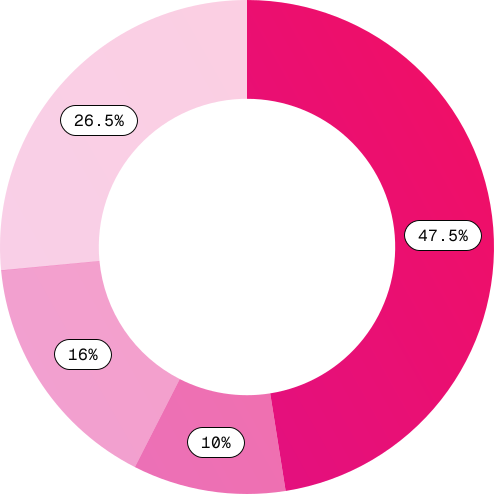
Ecosystem & Community – 47.5%
Nearly half of the tokens support ecosystem growth and community rewards. This pool funds pre-listing sales, user incentives (e.g. bug bounty bonuses, staking rewards), partnerships, airdrops, marketing, and liquidity. The large allocation ensures the token directly drives adoption and engagement.
Early Backers – 16%
Early backers and strategic backers receive 16% for supporting the project's mission and growth. Tokens are locked for one year and unlock over 36 months to align long-term commitment.
Team & Core Contributors – 26.5%
The founding team and core contributors receive 26.5%, locked over 36 months to ensure continued development and alignment with long-term value creation. The team must earn their tokens over time, which incentivizes continuous development and aligns the builders with long-term value creation.
Reserve – 10%
A small portion is held in reserve by the treasury for future needs and unforeseen opportunities to accelerate platform growth. This 10% acts as a safety buffer and growth fund.
Release Schedule
Why the Token Strengthens the Moat
Poorly designed tokens dilute value by commoditizing access. Well-designed tokens entrench network effects. IMU strengthens Immunefi's moat in three ways:
Risks
Security infrastructure operates in an adversarial environment where threats evolve continuously.
The risks below represent an honest assessment of what could prevent Immunefi from achieving its vision.
AI-Generated Noise at Scale
The risk: since late 2024, there has been a major increase in low-quality vulnerability submissions, primarily driven by researchers using LLMs to generate reports at scale. In traditional bug bounty programs, platforms like OSS-Fuzz have had to implement strict filtering after being overwhelmed by AI-generated noise that buried legitimate findings.
For Immunefi, this risk is acute. Unlike typical software where false positives merely waste time, in onchain security, false negatives can be catastrophic.
We're building three layers of defense:
- Machine learning triage that learns from historical patterns and researcher reputation scores
- Economic disincentives that penalize low-quality submissions
- Human-in-the-loop verification for high-severity findings, with ML as pre-filter rather than sole arbiter
What still concerns us: whether these systems hold at 100x volume, and whether sophisticated adversaries will specifically target filtering mechanisms to create exploitable blind spots. Filtering will likely become a permanent arms race rather than a solved problem.
Institutional Adoption Timing
The risk: the thesis depends on institutional capital moving onchain at meaningful scale within 3-5 years. Current indicators suggest this is happening: institutional AUM in digital assets surpassed $235 billion in 2025, with 83% of institutions planning to increase allocations.
However, this timeline could extend to 7-10 years if:
- Major exploits shake institutional confidence (e.g., a $5B+ loss at a regulated institution)
- Regulatory frameworks reverse or become more restrictive
- Macro conditions cause risk-off behavior
- Technical infrastructure takes longer to mature than expected
If institutional adoption is delayed, Immunefi remains a valuable but smaller business serving crypto-native protocols, without capturing the "security as take rate on trillions" opportunity on the projected timeline.
Institutional AUM in digital assets surpassed $235 billion in 2025, with 83% of institutions planning to increase allocations
What we're doing: the business is sized to be sustainable serving current crypto-native demand while positioning for institutional acceleration. The platform is profitable at current scale, reducing burn risk if the timeline extends. Direct relationships with institutions exploring onchain infrastructure provide early visibility into adoption signals.
What still concerns us: the pace of institutional adoption cannot be controlled. If timing is wrong by 5+ years, there is risk of competitors entering later with more resources once the opportunity becomes obvious.
Platform Security
The risk: as Immunefi becomes critical infrastructure, it becomes a high-value target. A breach would be catastrophic, exposing confidential vulnerability disclosures before patches deploy, compromising researcher identities, undermining trust across the ecosystem. When security providers fall (RSA, SolarWinds), consequences cascade across every system that trusted them.
What we're doing: Immunefi maintains SOC 2 Type 2 certification, validating that security controls operate effectively over time through continuous monitoring and annual independent audits. This is the same standard required by financial institutions.
The overwhelming majority of crypto security providers lack this certification.
Additional measures: bug bounties on our own infrastructure, regular penetration testing, encryption of all vulnerability data with need-to-know access, operational separation between platform and customer systems.
What still concerns us: insider threats, supply chain attacks, and nation-state actors remain difficult to fully mitigate. SOC 2 raises the cost of attack significantly but cannot guarantee invulnerability.
Competitive Risk
The risk: a well-funded competitor could attempt to replicate Immunefi's position through aggressive spending on researcher incentives, protocol acquisition, or technology development.
What we're doing: the moats described in this document, such as data advantage, researcher network, cross-protocol intelligence, trust accumulation, are not easily purchased. They are the result of five years of compounding in an adversarial environment. A competitor starting today would face the same cold-start problem Immunefi solved in 2020-2021, but in a market where Immunefi is already the default.
What still concerns us: security is a trust market, and trust can erode. A major operational failure, a poorly handled disclosure, or a breach of the platform itself could create an opening for competitors. Maintaining operational excellence is not optional.
Conclusion
The onchain economy has evolved from experiment to parallel financial system.
Trillions of dollars in value, hundreds of billions in institutional capital, and the infrastructure for tokenized real-world assets are already here or arriving imminently.
Security is the binding constraint on what comes next. Not regulation—MiCA is live, ETFs are approved, major banks are operating tokenized products. Not technology, as the infrastructure works. Not demand, since institutions are actively seeking onchain exposure.
The constraint is security: the inability to guarantee that capital deployed onchain will not disappear to exploits, hacks, or operational failures.
Until the loss rate approaches zero, institutional capital cannot fully commit. Until security is continuous rather than episodic, the composability that makes onchain finance powerful also makes it fragile. Until there is a unified security layer that operates at machine speed, defenders will continue losing to attackers who face no such constraints.
Immunefi exists to solve this problem. The platform unifies the fragmented security stack into a single command center. The researcher network—60,000+ contributors including the most elite whitehat hackers in history—surfaces vulnerabilities before attackers exploit them. The data advantage of the largest proprietary vulnerability dataset in existence enables defenses that improve with every incident.
The market opportunity is not a SaaS category. It is measured as a percentage of onchain GDP, i.e. security as the take rate on the financial system itself. As that GDP grows from trillions toward tens of trillions, security spend scales mechanically with value at risk. At even modest take rates, the opportunity is measured in tens of billions annually with a trajectory toward hundreds of billions as onchain finance becomes global financial infrastructure.
90%+ of all material bounty disclosures, the largest proprietary vulnerability dataset in existence
Immunefi's role evolves accordingly: from important platform to critical infrastructure. Assumed in diligence processes. Embedded in governance frameworks. Required for institutional participation. The switching costs compound—data, workflows, researcher relationships, institutional trust—making displacement increasingly difficult over time.
The IMU token aligns the ecosystem around this outcome. Researchers, protocols, and participants share in the security system's long-term success rather than treating security as a series of bilateral transactions. The token solves the coordination problem that centralized incentives cannot: aligning a global, pseudonymous, adversarial system around continuous security contribution.
The risks are real. AI-generated noise threatens to overwhelm human triage capacity. Institutional adoption timing remains uncertain. Platform security is an existential concern for any security provider. Competitive dynamics could shift if major failures erode trust.
But the structural advantages compound. Data gravity increases with every vulnerability processed. Network effects strengthen with every researcher and protocol added. Trust accumulates with every incident handled well. Switching costs rise with every workflow integrated. These advantages do not reset with market cycles. They accumulate over years.
The future of the onchain economy is determined by whether it can earn and sustain trust at scale. In financial systems, trust is ultimately a function of security. Immunefi is building the infrastructure to make that security possible—not as an optional enhancement, but as the foundation on which the next era of global finance will be built.